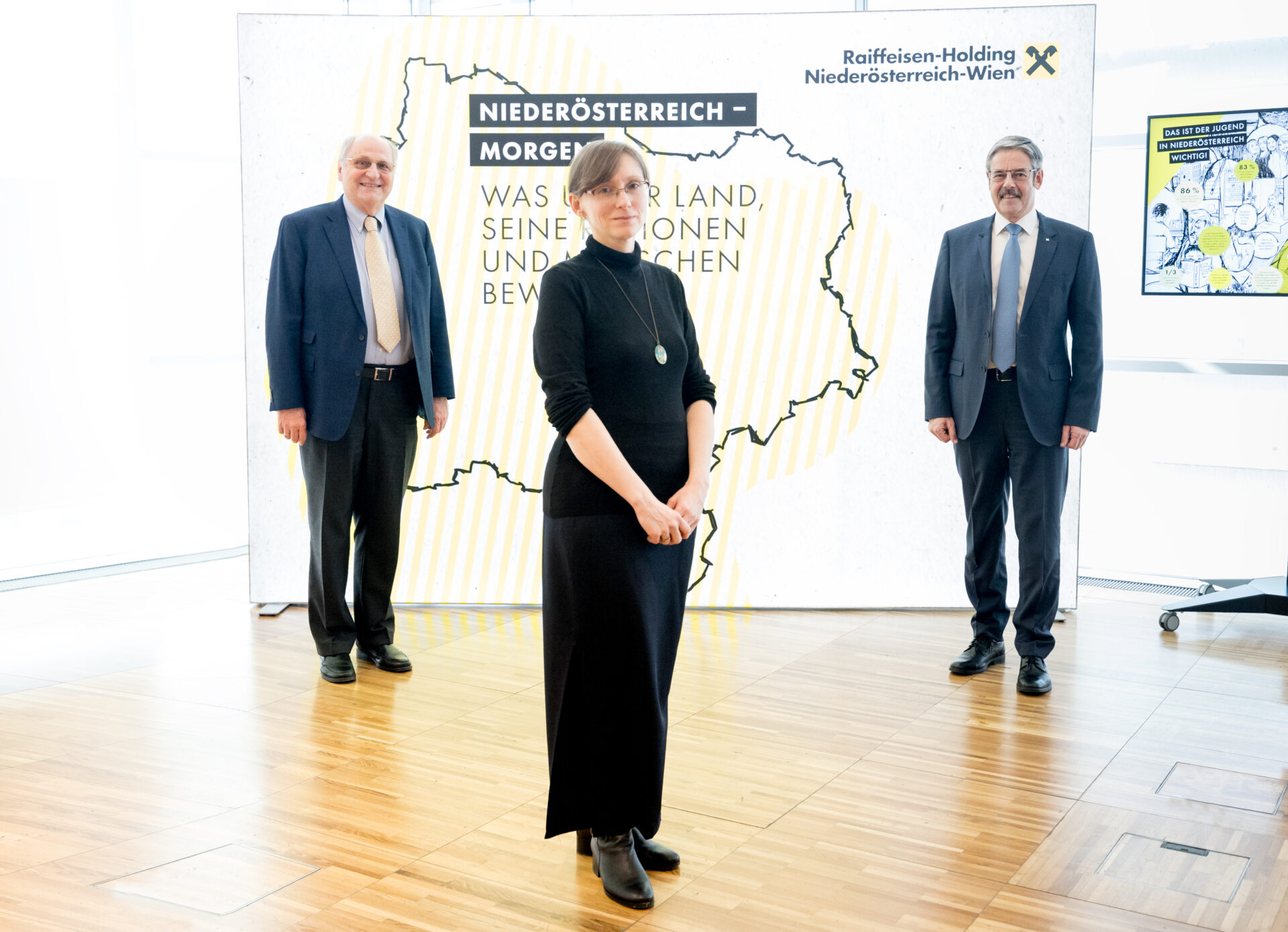
"Lower Austria – Tomorrow"
The social science study commissioned by Raiffeisen-Holding Niederösterreich-Wien is based on a comprehensive survey with approximately 16,000 people participated in 2019 and the analysis of secondary statistical data. It examines the living conditions and quality of life of the population in Lower Austria.
One finding that applies to Lower Austria is the high level of life satisfaction among the residents. However, a certain degree of uncertainty and scepticism can also be observed about the assessment of the future. For all Lower Austrians, family ties are very important, both today and in the future. Friendships and the wider social environment are also considered as important. Solidarity and cooperation also rank high in the respondents' value system. In Lower Austria, people feel a strong bond with their community, although there are sociodemographic and regional differences. In addition to their family and social environment, Lower Austrians are also very satisfied with their homes and neighbourhoods. Despite changing living conditions and the increasing availability of more flexible forms of housing, ownership continues to be a desired form of housing, although it is often expected that affordability will decrease in the future. In general, the housing cost burden is seen as a challenge; this applies both to their current assessment and – to an even greater extent – to those for the future.
Work-related aspects are rated less positively than the private aspects of life satisfaction. The occupational activity itself, the way to work as well as the balance between work and private life are seen by many Lower Austrians as a challenge, which the next generation will face to an even greater extent. Flexible forms of work such as home office or flexible working time are predominantly seen as a possibility to better reconcile work and family or leisure time. Lower Austrians are consistently satisfied with the prevailing offer of education and further training opportunities near home. A similar finding applies to the educational opportunities for children. However, more detailed results show selective deviations from the high general satisfaction. There is also potential for improvement in other areas of the local infrastructure: the provision of care for the elderly and health care facilities, also local public transport is particularly mentioned here. Long distances, especially in rural areas, have a negative impact on the quality of life. According to the results of the survey, Lower Austrians commute frequently, but not particularly gladly. People tend to accept commuting in order to be able to stay in their familiar surroundings.
The survey and the comprehensive analysis on "Lower Austria – Tomorrow" as well as parts of the (regional) dissemination of the results were already completed before the COVID-19-pandemic. However, the study results on the living conditions and quality of life of the Lower Austrian population in the dimensions of life, work, housing and mobility provide starting points for a better understanding of people's behaviour during the (still ongoing) COVID-19 crisis. In addition, the COVID-19 crisis confirms or further strengthens some fundamental findings of the study.
Publications
Please contact


Further news