Oil Price Shock Halts the Economic Recovery – Industrial Production Rises Despite the Trend in Orders
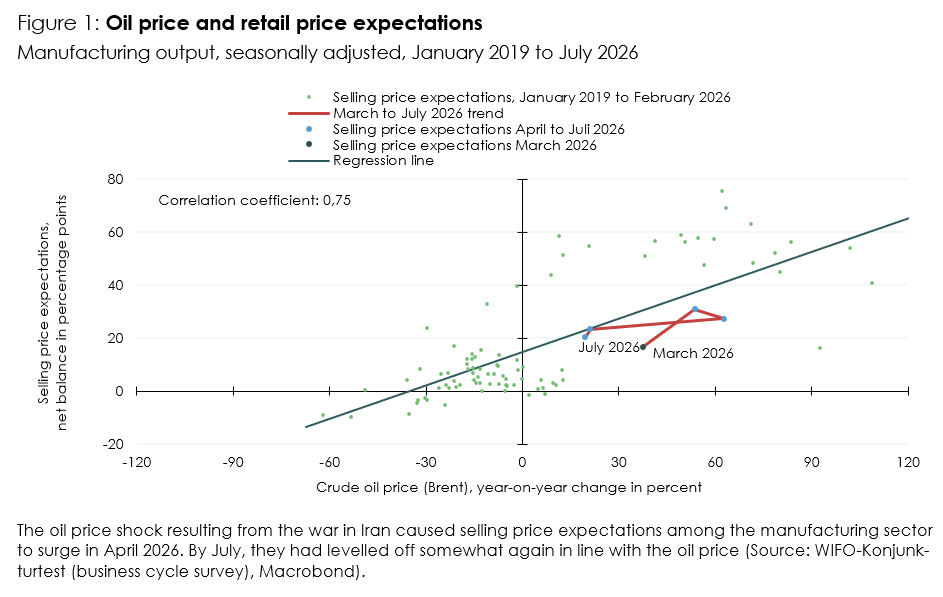
"Since the recent rise in crude oil prices, selling price expectations in the manufacturing sector have risen significantly once again. This clouds the prospects of a slowdown in general price inflation," says Christian Glocker, author of the latest WIFO Business Cycle Report.
According to the WIFO flash estimate from late July, Austria's gross domestic product stagnated in the second quarter of 2026 (±0.0 percent compared with the first quarter, seasonally and calendar-adjusted), having grown by 0.2 percent in each of the two preceding quarters. Compared with the same quarter of the previous year, growth stood at just 0.8 percent. The modest recovery observed since early 2025 has thus come to a halt for the time being. The decisive factor was the sharp rise in oil prices following the war in Iran, which weighed on the Austrian economy through higher energy and intermediate input costs, as well as the accompanying uncertainty.
On the supply side, the manufacturing sector, which had still been expanding in the first quarter, stagnated; in the construction sector, the decline in value added continued for the fifth consecutive quarter. In the services sector, the picture was mixed: the highest growth was recorded in financial and insurance services, whilst other business services and public administration in the broad sense suffered losses. On the demand side, both private and public consumption expenditure stagnated; the latter had still grown strongly in the first quarter. The public sector, which had propped up the economy on several occasions over the past two years, thus failed to act as a driving force for the time being. Only gross fixed capital formation rose slightly; there was hardly any impetus from foreign trade. On the distribution side, both wage income and capital income rose, although the latter increased at a significantly faster rate.
However, key leading indicators have recently brightened once again: the WIFO Business Climate Index improved in July compared with the previous month, and the UniCredit Bank Austria Purchasing Managers' Index signalled an expansion in industrial production for the fifth month running. This improvement, however, rests on a narrow basis: the sub-index for new orders fell in July, whilst that for export orders even reached its lowest level in a year. The recent expansion in production is thus fuelled by the clearing of order backlogs and the precautionary build-up of material stocks, rather than by additional demand.
Price inflation has recently eased, though this is largely due to one-off effects. According to a flash estimate by Statistics Austria, the Consumer Price Index in July 2026 stood at 2.7 percent above the previous year's level, down from +3.2 percent in June. Around half of this decline was attributable to the reduction in VAT on basic foodstuff with effect from 1 July 2026. Core inflation remained high at 3.1 percent, and energy prices rose even more sharply than in the previous month.
The labour market continued to perform robustly in July: the unemployment rate (national definition) remained virtually unchanged at 7.6 percent, and employment among wage earners continued to rise (both seasonally adjusted and compared with the previous month; provisional).
Publications
Please contact

Further news