08.02.2019

Macroeconomic Effects of Gender Equality

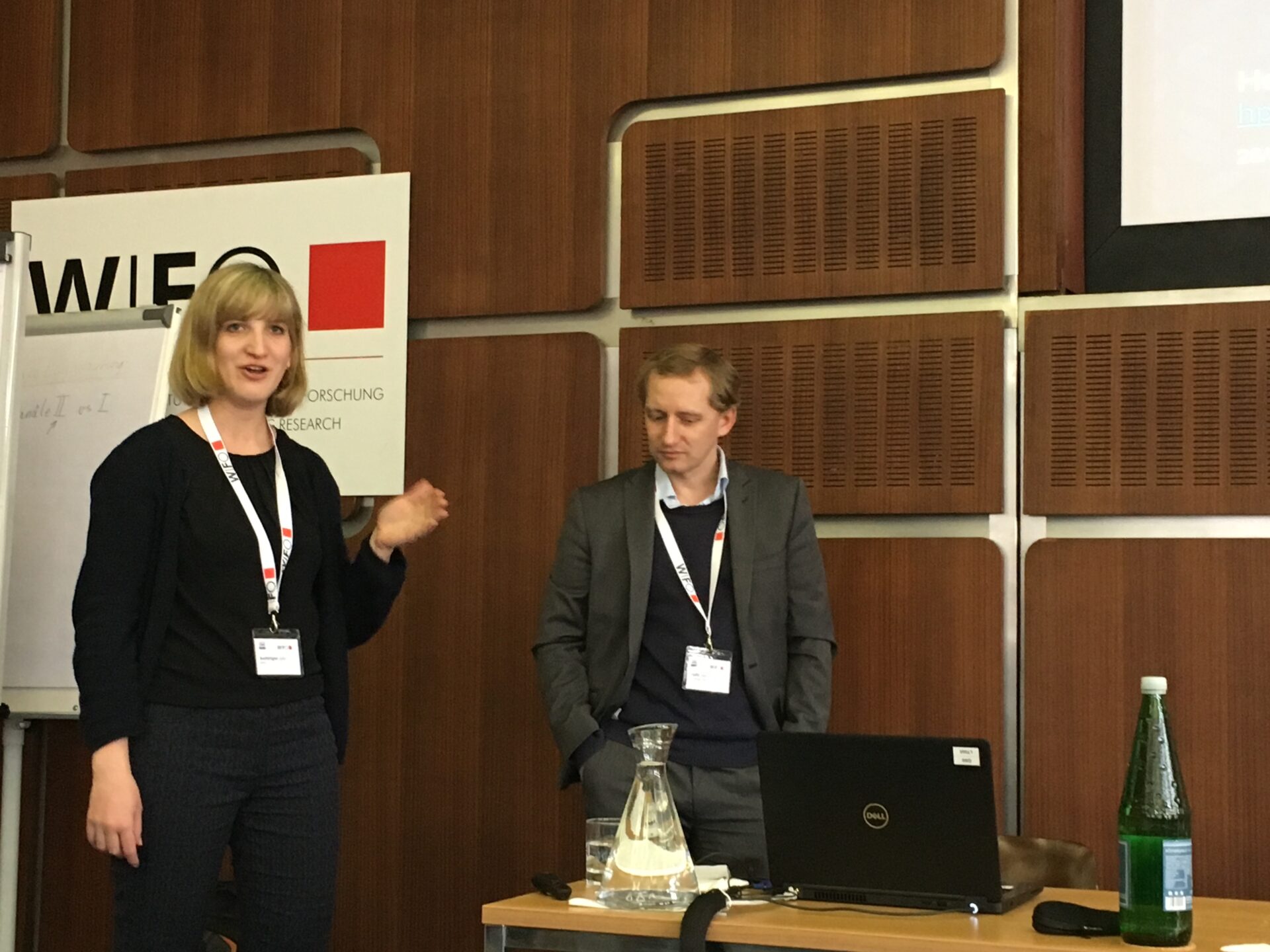
Hector Pollitt (Cambridge Econometrics) presents key findings on the macroeconomic effects of gender equality.
The socio-economic effects of gender equality from a macroeconomic perspective were the focus of a study for the European Institute for Gender Equality (EIGE) presented by Hector Pollitt (Cambridge Econometrics) in a WIFO-Extern. The analysis shows that an increase of equality between women and men can have positive effects on employment, income and GDP.

The study focuses on employment rates, participation rates, income and GDP as key macroeconomic variables that may be affected by improved gender equality in the Member States of the European Union. Four "pathways" to improving equality were defined:

  1. eliminating the gender gap in higher education.

  2. eliminating the gender gap in labour market participation.

  3. eliminating the gender pay gap.

  4. increasing fertility rates.

The model-based simulations carried out in the study show a positive influence on key macroeconomic variables for all four pathways. In particular, an alignment of women's participation rates with those of men has a positive effect on macroeconomic performance. Depending on the extent of the gender gaps in the baseline scenario, considerable differences between countries can be observed.

Video: Atanas Pekanov at Time to Decide Europe Summit 2025
09.12.2025
Association of European Economic Research Institutes Publishes General Report
04.12.2025
Legal Framework, Cost Analysis and Climate Impacts for Heating and Cooling in Austria
02.12.2025
WIFO Media Chat: Austria's Veto Under Scrutiny
02.12.2025
This was the Third Conference Organised by WIFO and BWB
28.11.2025
WIFO Research Brief Examines Bill Currently Under Review
18.11.2025
He was Vice-President of the Austrian Institute of Economic Research from 1990 to 2008
27.10.2025