Weekly WIFO Economic Index
WWWI for GDP and its subcomponents
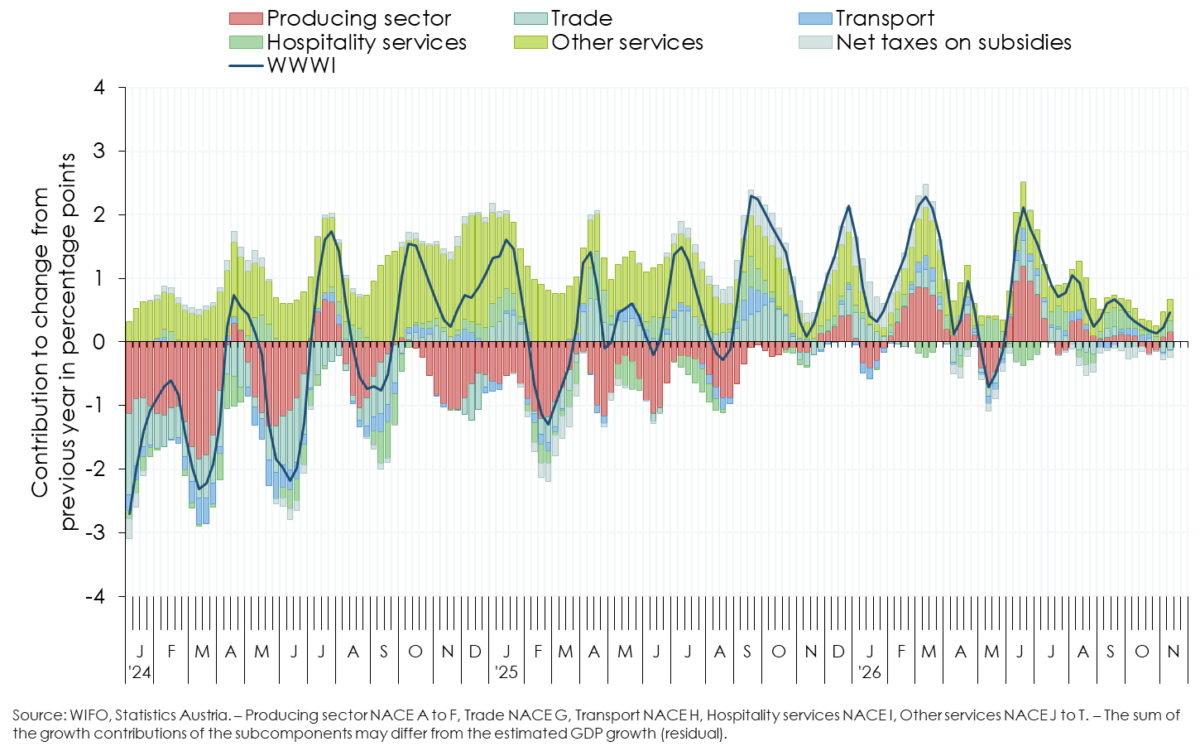
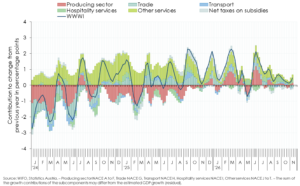
Based on the weekly indicator for GDP (WWWI), Austrian economic output in October (calendar weeks 40 to 44, 28 September to 1 November 2026) and in the first half of November (calendar weeks 45 and 46, 2 to 15 November 2026) was in each case ¼ percent higher than in the corresponding period of the previous year (September +½ percent, revised)1.
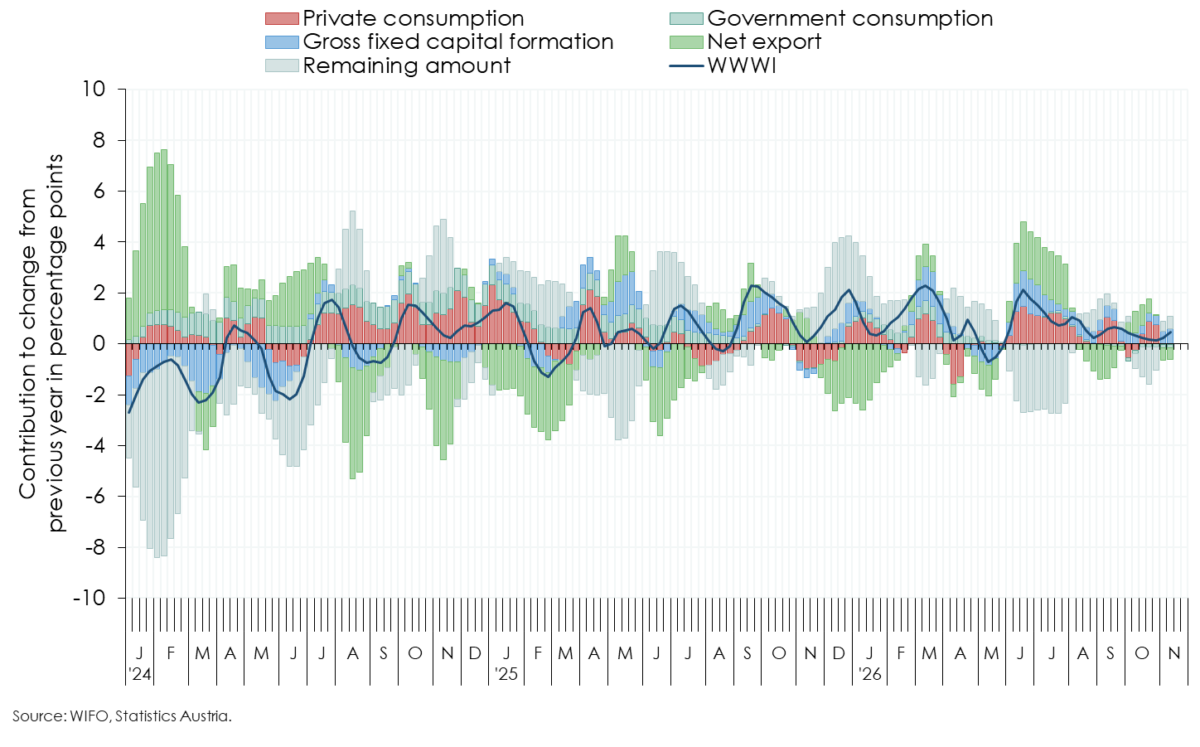
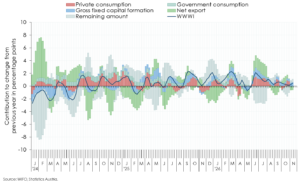
The inflation-adjusted volume of cashless transactions, used as an indicator of private household consumption expenditure, points to a year-on-year decline in demand for goods (retail sales) in October and to a marked increase in demand for services. Private consumption expanded by ½ percent compared with the previous year in October. In the first half of November it is estimated to have stagnated at the previous year's level (September +1¼ percent).
Investment dynamics are determined by economic output (industrial production) and by sentiment in the production sector according to the WIFO-Konjunkturtest (business cycle survey). Gross fixed capital formation is estimated to have increased by 1½ percent in October and by 2¼ percent in the first half of November compared with the previous year (September +1¾ percent).
The development of industrial production, tourism and the major demand components, and the resulting effects on foreign trade, imply a positive growth contribution to GDP of +½ percentage point in October from net exports in the broad sense.
Truck mileage on Austrian motorways and air freight volumes at Vienna Airport increased in October compared with the previous year, while rail freight transport stagnated. Passenger numbers at Vienna Airport have been below the previous year's level since the beginning of 2026 and declined further in October. Business sentiment in the transport sector according to the WIFO-Konjunkturtest has recovered since the slump at the start of the Iran war. On the basis of these indicators, value added in transport (NACE 2008, section H) is estimated to have increased by 1½ percent compared with the previous year in October and to have declined by ½ percent in the first half of November (September –1 percent).
The industrial production index (unadjusted) stagnated at the previous year's level in September. Dependent employment in the goods-producing sector (NACE 2008, sections A to E) continued to shrink (October –1.3 percent compared with the previous year). The number of unemployed persons in this sector has been rising more strongly again since mid-year (October +2.8 percent). Sentiment among manufacturers according to the WIFO-Konjunkturtest had deteriorated markedly at the start of the Iran war. While assessments of the current situation quickly recovered, expectations remained pessimistic in the following months but improved significantly in recent months. According to the WWWI estimate, economic output in the goods-producing sector grew by ¾ percent compared with the previous year in October and by 1¾ percent in the first half of November (September +1 percent).
The construction production index was 4 percent above the previous year's level in September. Employment in construction fell by 1.4 percent in October, while unemployment decreased in recent months (October –0.8 percent). According to the WIFO-Konjunkturtest, construction companies have again been predominantly optimistic for some time, although the assessment of the current situation is improving only slowly. Value added in construction (NACE 2008, section F) continues to decline: in October the decrease was 2¾ percent compared with the previous year and in the first half of November 3¾ percent (September –2 percent).
Based on cashless transactions in restaurants and hotels as well as on sentiment indicators from the WIFO-Konjunkturtest, value added in tourism (accommodation and food service activities, NACE 2008, section I) is estimated to have increased by 3¼ percent compared with the previous year in October. In the first half of November it expanded by 5 percent (September +5¾ percent). In trade (NACE 2008, section G), value added fell by ¼ percent year-on-year in October on the basis of cashless payments. For the first half of November, a further decline in value added of 1¾ percent compared with the previous year is estimated (September +¾ percent).
The current employment situation in business-related market services and sentiment indicators from the WIFO-Konjunkturtest point to a continued overall positive development in this sector. For the remaining market-related services (NACE 2008, sections J to N), an increase in value added of 1 percent compared with the previous year is estimated in October. In the first half of November, growth amounted to 1½ percent (September +1¼ percent). In other personal services (NACE 2008, sections R to T), value added is estimated to have expanded by ¾ percent in October and by 1¼ percent in the first half of November, based on employment trends and business sentiment according to the WIFO-Konjunkturtest (September +½ percent).
1 The inclusion of newly published and revised monthly data, which must be reconciled when estimating the WWWI, led to a revision of the WWWI for GDP. Notable production-side WWWI revisions occurred in the areas of goods production (NACE 2008, sections A to E) and remaining market-related services (sections J to N).
Weekly Economic Activity, WWWI – Production, WWWI – Demand The WWWI is under constant development; it is regularly reviewed and will be expanded with new and additional weekly data series as they become available. The WWWI is not an official quarterly estimate, forecast or similar of WIFO.
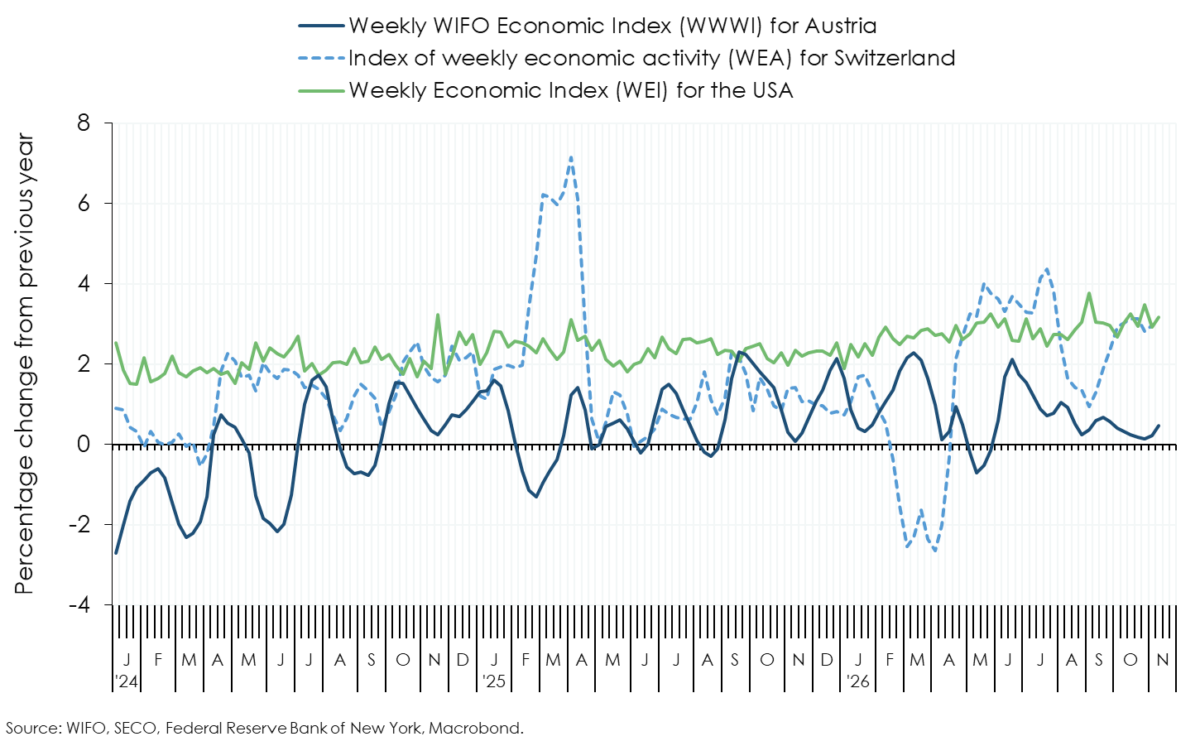
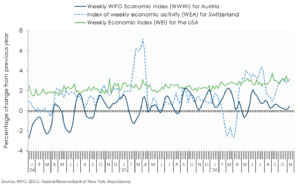
The Weekly WIFO Economic Index (WWWI) is a measure of the real economic activity of the Austrian economy on a weekly and monthly frequency. It is based on weekly, monthly and quarterly time series to estimate weekly and monthly indicators for real GDP and 18 GDP sub-aggregates (use side 8, production side 10) of the Quarterly National Accounts.
With the release for June 2022, the econometric models for the historical decompositions and for nowcasting have been converted to seasonally unadjusted time series. In addition, year-on-year growth rates are now used to estimate the models.
The WWWI estimates are (currently) updated monthly and published on the WIFO website.
Please contact

Further news