Austria's Construction Output in 2029 will Still be 5.8 Percent Below 2023 Levels
Euroconstruct was founded in the mid-1970s and is a network of research institutes from 19 European countries that produces forecasts for the European construction industry twice a year. WIFO is the Austrian partner and is currently hosting the 102nd Euroconstruct Conference in Vienna.
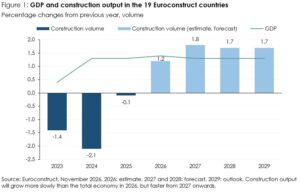
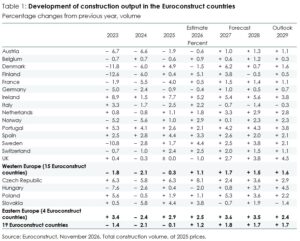
After three years of decline, the European construction sector is expanding again, although the upturn is weaker than forecast. Construction output in the 19 Euroconstruct countries will increase by 1.2 percent in real terms in 2026; in June, the institutes had still expected a rise of 2.0 percent. From 2027 onwards, the recovery will gain momentum, but in Austria, France, Italy and Germany, construction output will remain below 2023 levels even in 2029. The key findings of the new forecasts will be presented on 20 November 2026 at the 102nd Euroconstruct Conference in Vienna. The event is being hosted by WIFO, the network's Austrian partner.
"The recovery of the European construction sector is proving weaker than recently anticipated, as interest rates and construction costs have risen. If inflation remains above the target level, the upturn in residential construction in particular could be delayed once again. Austria is emerging from the crisis more slowly than its neighbours: the recovery from 2027 onwards will not be sufficient to return to 2023 levels by 2029. Residential construction in particular lacks momentum in this country", says WIFO economist Michael Klien.
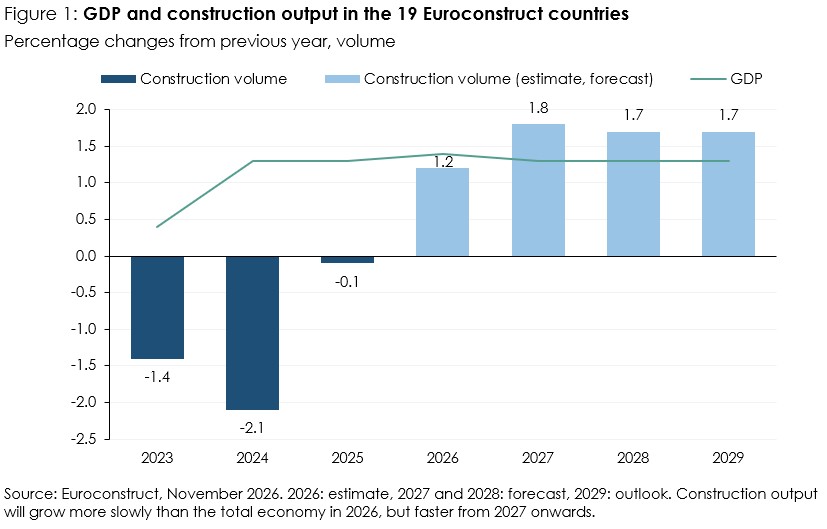
The total economy of the Euroconstruct countries has already recovered slightly: real GDP in the 19 countries grew by 1.3 percent in both 2024 and 2025, and is set to rise by 1.4 percent in 2026. However, the construction sector is still benefiting very little from this and will grow more slowly than the total economy in 2026.
From 2027 onwards, this trend will reverse. Construction output rises by 1.8 percent in 2027 and outpaces GDP growth every year until 2029. Over the period from 2026 to 2029, the construction sector records an average real growth rate of 1.6 percent per year, whilst economic output grows by 1.3 percent. The total economy is developing more steadily: its growth rate remains virtually constant, whilst the construction sector transitions from a phase of contraction to one of recovery.
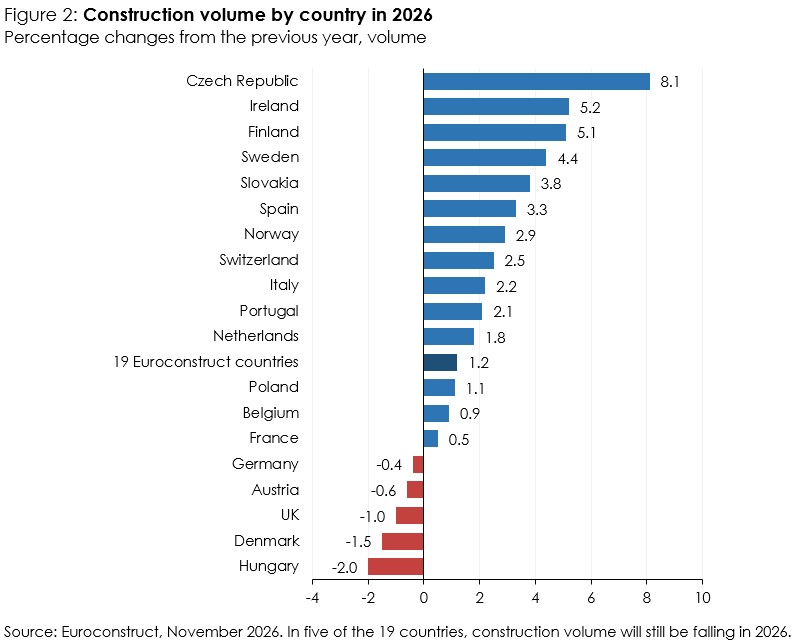
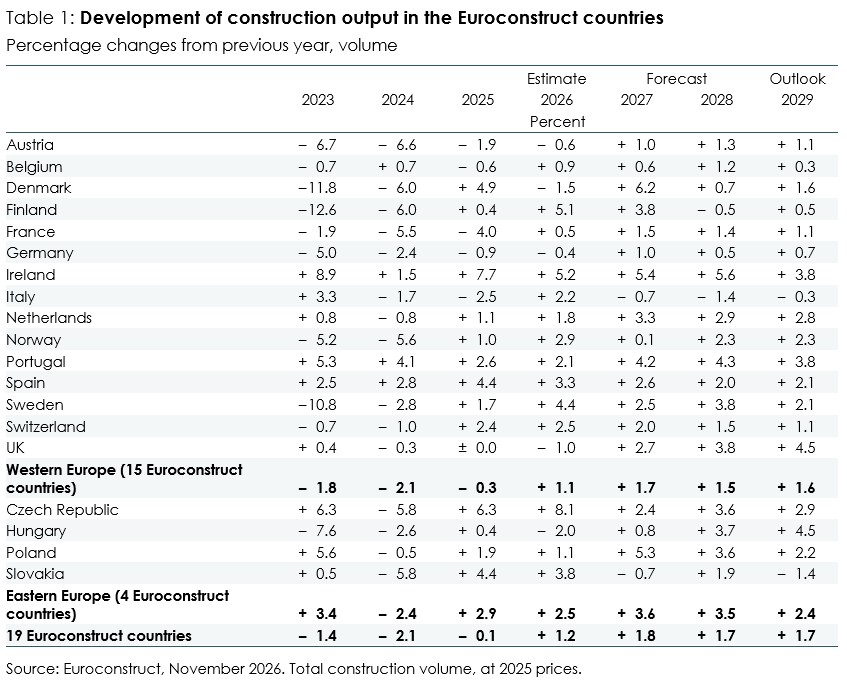
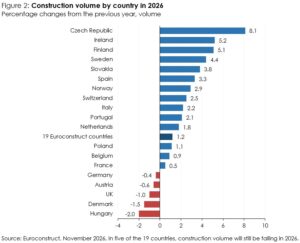
Across all 19 countries, construction output will once again exceed the 2023 level in 2027 and will be 4.1 percent higher in 2029. However, this overall result masks marked regional differences. In the four Eastern European countries, construction activity will expand by 3.0 percent per year from 2026 to 2029 – roughly twice as fast as in Western Europe (1.5 percent). The strongest growth will be seen in Ireland (+5.0 percent), the Czech Republic (+4.2 percent), Portugal (+3.6 percent) and Sweden (+3.2 percent; annual average in each case). In five of the 19 countries, however, the construction sector will still be contracting in 2026, including Austria.
The recovery is also only partially taking hold in major markets: Germany, France and Italy – three of the four countries with the highest construction output in the network – will remain below their 2023 baseline levels in 2029.
The forecast risk increases with the time horizon; even the current estimate for 2026 is already significantly lower than that of June. If inflation persists above the target level, as WIFO economist Michael Klien points out, the acceleration forecast from 2027 onwards could also be delayed once again. Investment and financing decisions that rely on this upturn should therefore be reviewed in the event of a further delay.
The 102nd Euroconstruct Conference is currently taking place at the Haus der Industrie in Vienna under the theme "Understanding What Moves the Market". The conference reports contain the full forecasts up to 2029 for all 19 countries (www.euroconstruct.org).
Please contact

Further news