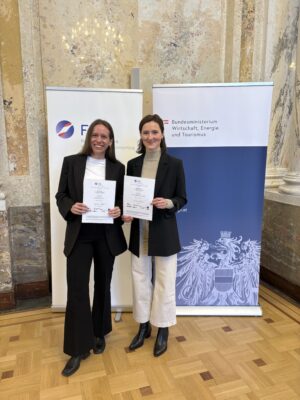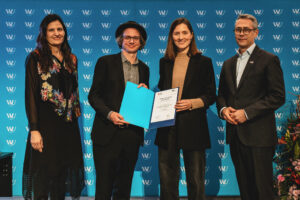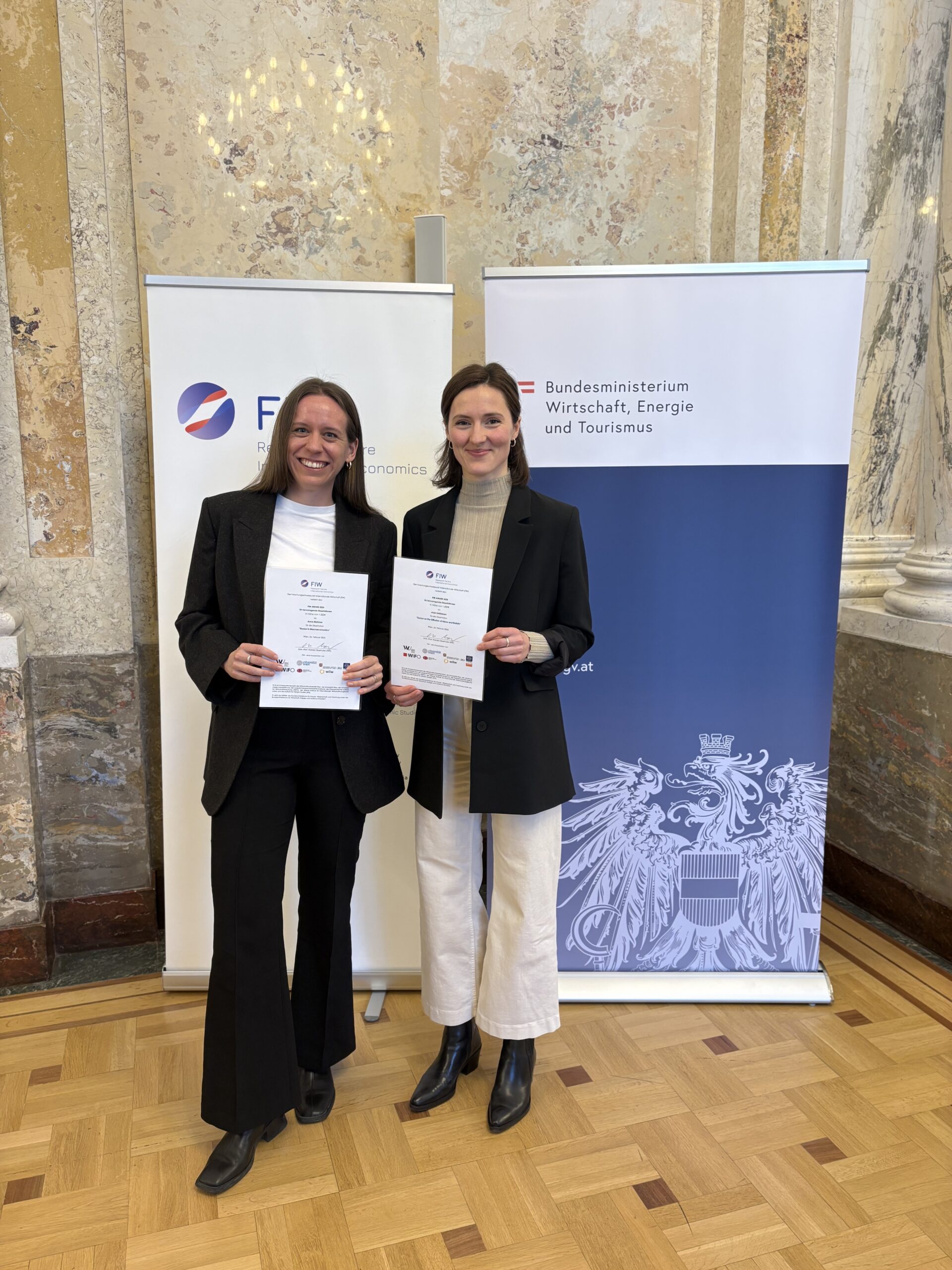
FIW Award for Anja Sebbesen
The dissertation, written between 2016 and 2024, was completed as part of the PhD programme in Economic and Social Sciences at the Vienna University of Economics and Business and supervised by WU professors and WIFO consultants Harald Badinger and Jesús Crespo Cuaresma. While working on her thesis, Anja Sebbesen was initially employed as a pre-doctoral research assistant at the Department of Economics at WU and continued to complete her dissertation while working at the Austrian Institute of Economic Research (WIFO).
The award-winning cumulative dissertation comprises three independent contributions that examine different levels of diffusion – from global technology dissemination to the exchange of firm expectations along European value chains to direct interactions between companies at trade fairs.
In the first contribution, "Technology Diffusion across Regions," Sebbesen examines how technological developments spread across subnational regions. Based on a spatial growth model and a globally comparable data set for 569 regions in 30 countries, the role of human capital, technological backwardness, spatial proximity and direct investment in the growth of total factor productivity (TFP) is analysed. The results confirm that poorer regions benefit from technological catch-up, with the speed of catch-up increasing significantly with higher levels of education and stronger inflows of foreign direct investment. At the same time, the study shows positive spatial spillover effects from high technology levels in neighbouring regions.
The second paper, "The Propagation of Business Expectations within the European Union," focuses on the spread of firm expectations across industries and countries. To this end, Sebbesen links EU-wide harmonised business survey data with international input-output tables and models the interdependencies using dynamic space-time models. The estimates provide robust evidence of spillover effects in the formation of expectations along European value chains: expectations are transmitted to both suppliers (upstream) and customers (downstream), with the downstream channel having a stronger effect. Positive or negative expectation impulses in one industry thus spread to numerous other industries and countries via trade in intermediate goods.
In the third paper, "I Think What You Think: Trade Fairs and the Exchange of Firms' Beliefs," Sebbesen examines the role of direct interactions between companies in the formation of expectations. Based on a newly compiled data set that links exhibitor lists from Austrian trade fairs with a company panel from the WIFO Economic Survey, she shows that after exhibiting at a trade fair, firms' production expectations respond more strongly to the prevailing consensus of other exhibiting companies. In phases of widespread optimism, for example, the probability that a company itself expects an increase in production rises significantly immediately after exhibiting at a trade fair, while it falls noticeably when expectations are predominantly pessimistic. The work thus provides initial microeconomic evidence that trade fairs function as hubs for information exchange and expectation alignment.
Overall, Anja Sebbesen's dissertation contributes to our understanding of how ideas, technologies and beliefs about the future spread in networked economies – from regional technology adaptation to the exchange of economic expectations in production networks to direct interaction at the company level. The work combines modern methods of spatial and network analysis with high-quality micro and macro data and shows that diffusion processes at various levels contribute significantly to shaping the economic environment of regions, industries and companies.
Anja Sebbesen joined WIFO in March 2023 as an economist in the research group "Regional Economics and Spatial Analysis". Her research interests lie in regional economics, with a particular focus on regional linkages and spatial spillover effects. Her research also deals with expectation formation of firms, where she again focusses on interdependencies between firms. Anja Sebbesen worked as a research assistant and PhD student at the Vienna University of Economics and Business from 2016 to 2023 (interrupted due to maternity leave). During this time, she presented papers at numerous international conferences and workshops. In 2020, she received the Edwin-von-Böventer Prize of the German-speaking section of the European Regional Science Association (GfR), in 2018 the FIW Award for outstanding master's theses, and in 2017 the "Young Researcher Prize" of the Spanish Asociación Libre de Economía.
Please contact

Further news