"Good and Bad Inflation"
Inflation in the euro area and in Austria is subject to strong fluctuations due to the COVID-19 crisis, which in turn are attributable to global developments. To better understand these fluctuations, it is worth breaking them down into demand-side and supply-side effects. If price inflation is demand-driven, it follows an economic upswing ("good" inflation). If it is supply-driven, it may be caused, for example, by supply difficulties, i.e. a burden on the economy ("bad" inflation).
Figure 1 shows how global demand and supply shocks shaped inflation in Austria and the euro area over the past year and a half. From the outbreak of the COVID-19 crisis in January 2020 to its temporary peak in May 2020, negative demand-side stimuli continuously intensified and dampened inflation. At the same time, however, there were also supply-side distortions that counteracted this dampening effect, e.g. the disruption of international supply chains. Only in March 2020 did this supply-side price pressure ease briefly when OPEC temporarily expanded crude oil production sharply in the wake of an oil price dispute.
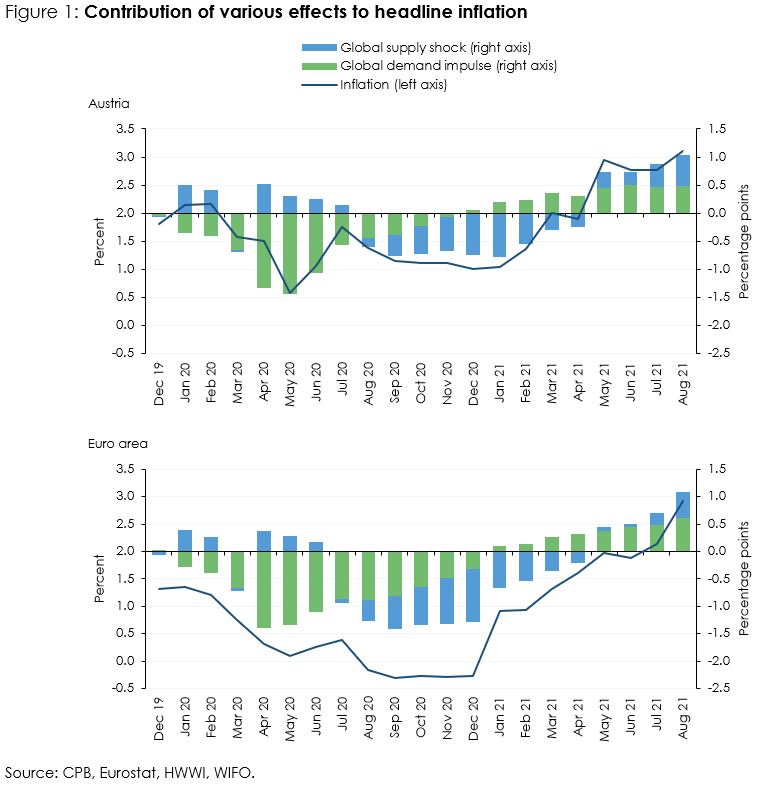
The nascent economic recovery started to push up prices as early as May 2020 (euro area) and June 2020 (Austria). At the same time, a favourable supply situation prevailed in the second half of 2020, which dampened inflation. It is only since 2021 that both demand-side stimuli (the further improvement in the global economy) and supply-side shocks (supply bottlenecks) have had a price-driving effect.
In Austria, demand-side price pressures have stagnated at a high level since May 2021, while in the euro area they increased further over the summer. However, supply-side price pressure has also intensified in recent months; in Austria, it already had a stronger impact on inflation than global demand impulses in August 2021. In September and October, supply-side price pressures are likely to have remained high due to developments in global gas prices.
For econometric details, see the box "Effects of the Global Economy on Inflation in Austria" in WIFO's Economic Outlook from October 2021.
Please contact

Further news