Weekly WIFO Economic Index
WWWI for GDP and its subcomponents
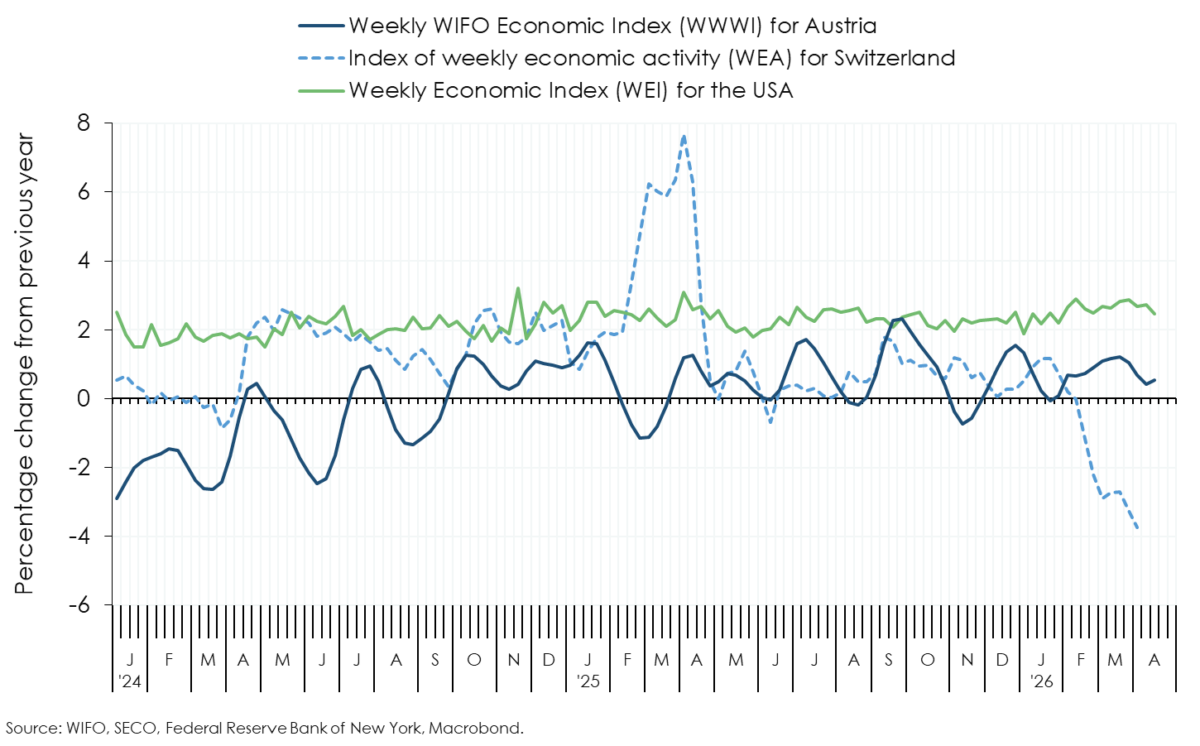
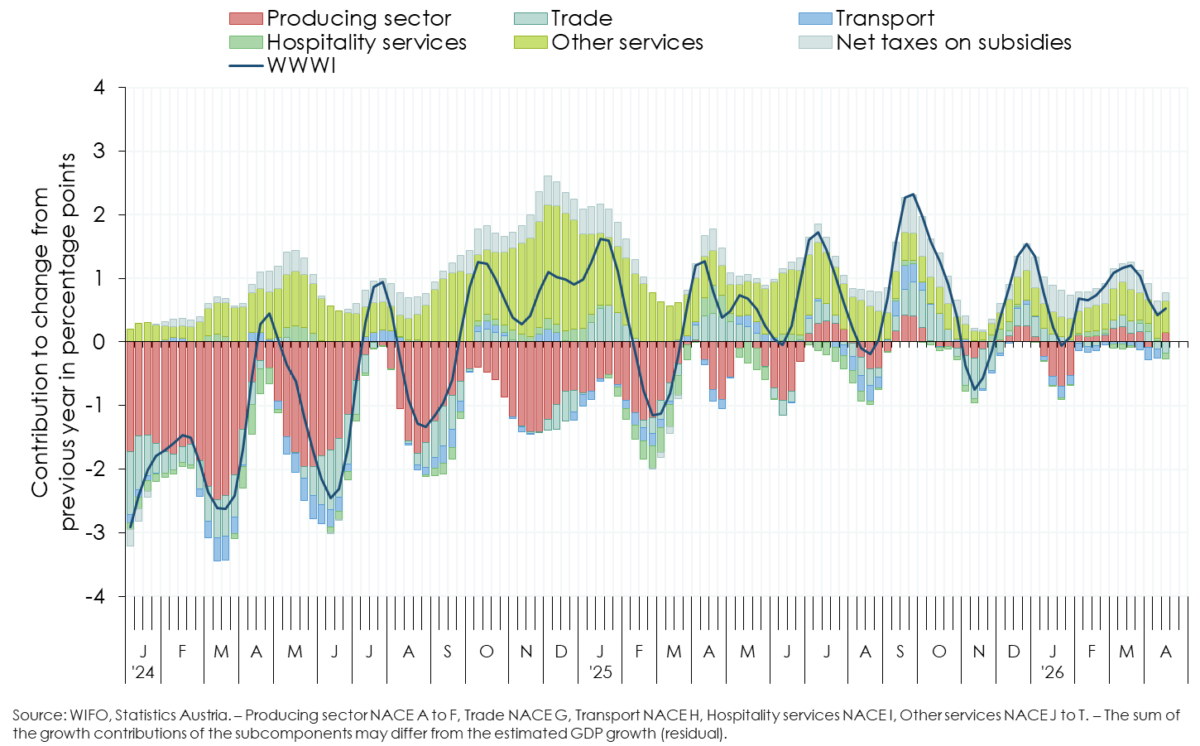
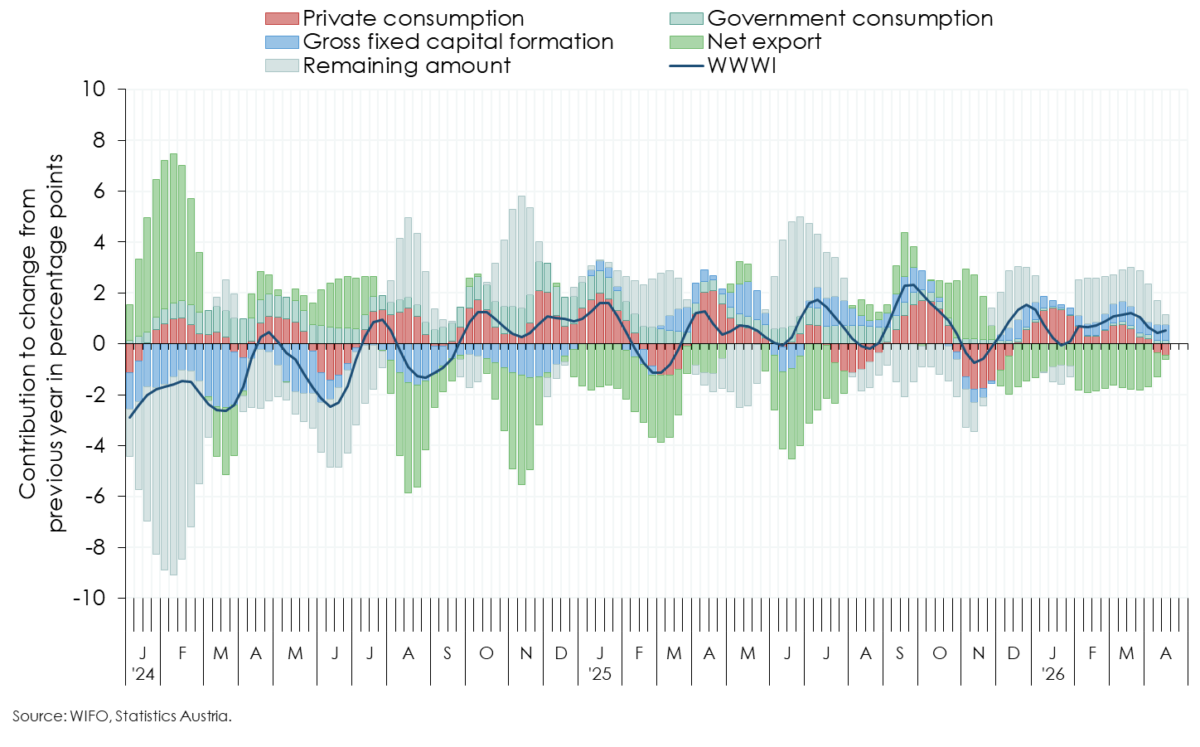
Based on the weekly indicator for GDP (WWWI), domestic economic output rose by 1 percent in March (calendar weeks 10 to 13, 2 to 29 March) and by ½ percent in the first three weeks of April (calendar weeks 14 to 16, 30 March to 19 April) compared with the same period last year (February +¾ percent, revised)1.
The inflation-adjusted volume of cashless transactions, serving as an indicator of household consumption expenditure, suggests a year-on-year increase in demand for goods (retail sales) and services in March. Private consumption rose by 1¼ percent year-on-year in March and is expected to have fallen by ½ percent in the first three weeks of April (February +1 percent).
Gross fixed capital formation is driven by economic output (industrial production) and by sentiment in manufacturing according to the WIFO-Konjunkturtest (business cycle survey). Compared with the previous year, investment is expected to have risen by 3¼ percent in March and by 2½ percent in the first three weeks of April (February +2¼ percent).
Based on developments in industrial production and tourism, as well as major demand components and the resulting effects on foreign trade, net exports in the broad sense made a negative contribution to GDP growth of 1¾ percentage points in February and March, and 1 percentage point in the first three weeks of April.
Truck mileage on Austria's motorways increased in March compared with the previous year, whereas rail freight transport and passenger and cargo volumes at Vienna Airport fell. Air traffic is likely to have suffered a setback as a result of the war in Iran. According to the WIFO-Konjunkturtest, the majority of companies in the transport sector (NACE 2008, section H) continue to view the current situation negatively. Business sentiment is likely to have deteriorated significantly in April. Based on these indicators, a year-on-year decline in value added is estimated for the transport sector of 1¼ percent in March and 2¼ percent in the first three weeks of April (February –1½ percent).
The industrial production index rose significantly in December 2025 compared with the previous year, but in January 2026 (revised) it was below the previous year's level. Growth was observed again in February 2026, based on preliminary data. Employment in the goods-producing sector (NACE 2008, sections A to E) continued to fall (February and March –1 percent year-on-year in each case). The number of jobseekers in this sector rose slightly again in the following months after a brief easing at the turn of the year 2025-26. According to the WIFO-Konjunkturtest, sentiment among manufacturing companies improved until the start of 2026, but on balance, assessments remained in negative territory. Most recently, assessments have deteriorated (significantly) again. WIFO estimates that economic output in the goods-producing sector was 1¼ percent higher than in the previous year in both February and March, and ½ percent higher in the first three weeks of April.
The production index for construction was down by just under 11 percent (unadjusted, revised) on the previous year in January due to weather conditions and remained flat in February. Employment in the construction sector continued to fall. The number of persons registered as unemployed fell in March compared with the previous year, following an increase in January and February. Sentiment among construction companies remains sceptical. Whilst assessments of the current situation are still in negative territory and well below the long-term average, expectations have recently signalled an improvement in sentiment. Value added in construction (NACE 2008, section F) is estimated to have been 1 percent lower in March and 1¼ percent lower in the first three weeks of April than in the same period of the previous year (February –2¾ percent).
Based on cashless transactions in restaurants and hotels and sentiment indicators from the WIFO-Konjunkturtest, value added in tourism (accommodation and food services, NACE 2008, section I) is estimated to have fallen by ½ percent year-on-year in March and risen by ¾ percent in the first three weeks of April (February +1¼ percent). In trade (NACE 2008, section G), value added is expected to have increased by 1¾ percent year-on-year in March and to have fallen by ½ percent in the first three weeks of April (February –¼ percent).
The current employment situation in the remaining market-related services (NACE 2008, sections J to N) and the sentiment indicators from the WIFO-Konjunkturtest point to a continued generally positive trend in this sector. For the remaining market-related services, value added growth of 1 percent and ¾ percent respectively is expected in March and the first three weeks of April compared with the previous year (February +1 percent). In other personal services (NACE 2008, sections R to T), value added is estimated to have grown by 2 percent in both February and March and by 2½ percent in the first three weeks of April, based on employment trends and business expectations according to the WIFO-Konjunkturtest.
1 The inclusion of newly published and revised monthly data, which must be taken into account when estimating the WWWI, led to a revision of the WWWI for GDP. Notable supply-side WWWI revisions occurred particularly in the areas of goods production (NACE 2008, sections A to E), construction (section F), accommodation and food service activities (section I), trade (section G) and remaining market-related services (sections J to N).
Weekly Economic Activity, WWWI – Production, WWWI – Demand The WWWI is under constant development; it is regularly reviewed and will be expanded with new and additional weekly data series as they become available. The WWWI is not an official quarterly estimate, forecast or similar of WIFO.
The WIFO Weekly Economic Index (WWWI) is a measure of the real economic activity of the Austrian economy on a weekly and monthly frequency. It is based on weekly, monthly and quarterly time series to estimate weekly and monthly indicators for real GDP and 18 GDP sub-aggregates (use side 8, production side 10) of the Quarterly National Accounts.
With the release for June 2022, the econometric models for the historical decompositions and for nowcasting have been converted to seasonally unadjusted time series. In addition, year-on-year growth rates are now used to estimate the models.
The WWWI estimates are (currently) updated monthly and published on the WIFO website.
Please contact

Further news