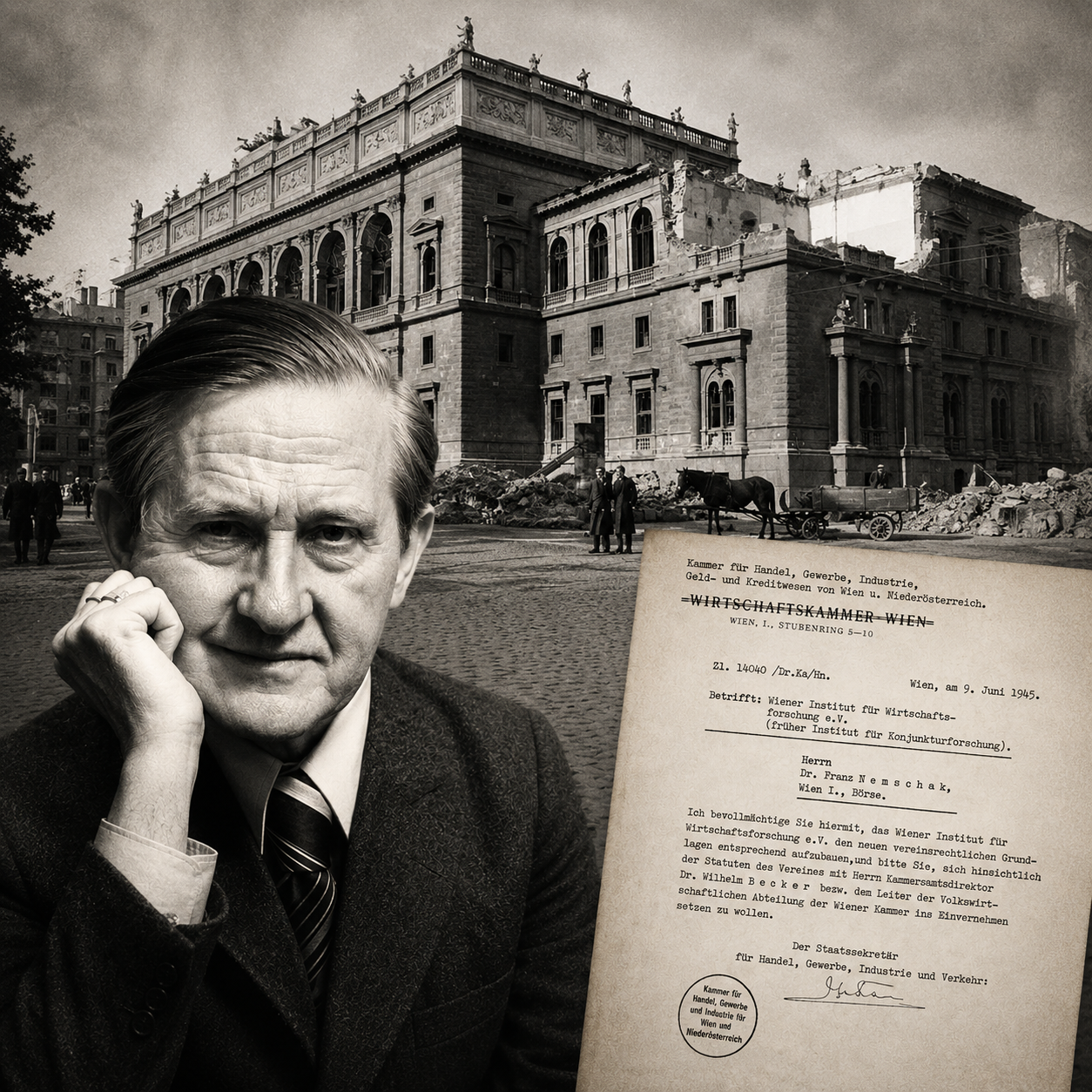
"Actually Entirely Without Any Official Mandate"
The radio feature (in German) is available in the "Austrian Media Library".
Below is a transcript of the ORF interview conducted on the occasion of Franz Nemschak's 75th birthday.
Host Ilse Vogel:
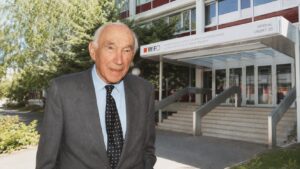
A man whose birthday is today had a decisive influence on Austria's postwar economic policy: Professor Dr. Franz Nemschak, founder and first director of the Institute of Economic Research after the war.
The Institute itself had already existed during the war, and Nemschak had been working there as early as the beginning of the 1940s. After 1945, without initially having any official mandate, he reactivated the Institute of Economic Research.
Nemschak was born on 27 July 1907, in Graz. He began his studies relatively late, in 1933, studying economics, sociology, and political science. Among other things, Nemschak worked as a commercial employee at Kastner & Oehler, the large department store in Graz, and as a business lawyer at the Böhler steelworks in Kapfenberg.
In 1972, Nemschak handed over leadership of the Institute for Economic Research to his then-colleague Professor Seidel, who today serves as State Secretary in the Ministry of Finance, while the Institute now has Dr. Helmut Kramer as only its third postwar director.
Until 1978, Professor Nemschak also headed the Institute for International Economic Studies, which primarily studied the differences between Western and Eastern economic systems and had emerged from a department within the Institute of Economic Research.
Since 1978, Professor Dr. Franz Nemschak has been retired. Today he celebrates his 75th birthday, and on this occasion Hans Adler spoke with him.
Hans Adler:
Professor Nemschak, after the war in 1945, you essentially re-established the Institute of Economic Research on your own initiative. At the time, there was no official mandate and no one who could even have given you one.
Franz Nemschak:
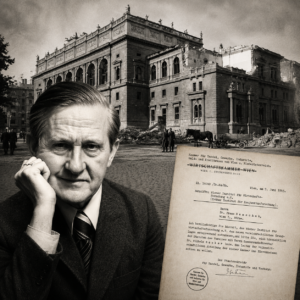
Yes, that is really how it was. During the war, I came into contact with economic research more or less by chance. I had received leave from military service and became interested in economic research. I went to what was then the Vienna Institute for Economic Research, which was housed in the stock exchange building and was essentially in the process of dissolving. The male members had returned to the "Old Reich." And there I stood alone with a handful of female assistants.
I occupied rooms in the stock exchange building that had remained intact, actually entirely without any official mandate. At the time, I happened to hear that a well-known figure from Austria – from the former Austria – Minister Heinl, had appeared at the Chamber of Commerce on Stubenring.
So I fought my way through rubble and ashes from the stock exchange building to Stubenring – which was no easy task – in order to meet Heinl. And Heinl encouraged me and even told me that his party had now entrusted him with rebuilding the chambers in Austria, and that he considered my initiative excellent.
And he said that he would probably hold a position in the provisional government that was to be formed in a few days – indeed, the provisional government was formed one week later – and that he would then legitimise and regularise everything I had done. And that is exactly what happened.
I then spent the following months establishing the Institute's governing board. I based it on the original idea that representatives from both sides should be included: representatives of employers as well as workers. Specifically, the leading officials – the presidents of the Chamber of Labour, the presidents of the Chamber of Commerce (at the time still the Vienna Chamber of Commerce), the presidents of the Trade Union Federation, the presidents of the Federation of Austrian Industry, the president of the Banking Association, and a representative of the state. So I assembled a board in which the leading representatives of the economic institutions as well as the state were represented.
Hans Adler:
But doesn't that lead to too much outside influence over the decisions of such an institute?
Franz Nemschak:
Yes, but it was expressly stipulated – and I adopted this from my predecessors von Mises and Hayek – that the director of the Institute must remain completely independent in selecting staff and determining the Institute's work.
Hans Adler:
When one looks at these institutes and works with them, one sees that they actually perform a very broad range of tasks, while only the forecasts appear in public and are endlessly debated. In your opinion, are these forecasts really such a central aspect – predicting the future course of the economy? Or is the main focus not rather the analysis of existing conditions and the possible reactions derived from them?
Franz Nemschak:
It is both. The main focus is certainly continuous analysis – ongoing analysis of existing conditions within one's own country in various fields, but also of the international situation. One needs both. Analysis is, of course, the foundation.
Hans Adler:
Do you actually envy your successors? You made your forecasts during a period of economic prosperity, during the reconstruction era, when one could assume with relative certainty that every economic downturn would eventually be followed by renewed growth. Today one can no longer rely on that. In other words, forecasting was not quite as difficult in your day, because if you got something wrong, the economy would eventually correct itself. Today mistakes hurt, and every inaccurate forecast is scrutinised critically. Are you perhaps glad that you no longer have to do this?
Franz Nemschak:
Forecasts were always somewhat problematic, even in my time. It is true that during the postwar period – despite certain setbacks – there was a long-term upswing over two or three decades during which gross national product quadrupled. Under those circumstances, it was comparatively easier to make reasonably accurate forecasts. The question was always merely by how much the national product would grow: would it be 3, 5, or 4 percent?
Of course there were downturns as well. For example, there was the severe collapse before the first price-wage agreement in 1951, when Marshall Plan aid ended. In Austria inflation became extremely virulent – by then it was already the fifth price-wage agreement – and in autumn the cost-of-living index had risen by 45 percent or nearly 50 percent compared to the previous year. A galloping inflation was underway, and under those circumstances forecasting was naturally extraordinarily difficult.
Hans Adler:
In today's crisis, people sometimes say that it resembles the 1930s. You personally experienced the 1930s. Do you really see comparable conditions? And have the instruments of economic policy and the overall situation developed in a similar way? Are we facing a new situation today with essentially the same tools?
Franz Nemschak:
In the 1930s – and already in the 1920s – there was class conflict bordering on destruction and violence. Political parties stood in open hostility toward one another. There was not the slightest trace of cooperation.
I drew lessons from that, and my vision was that the enormous difficulties we faced after the Second World War could only be overcome if we found forms of cooperation. The entire atmosphere at that time was completely different.
Hans Adler:
And today – how does it look today?
Franz Nemschak:
Today that generation is essentially gone. And the younger persons who are now here – relatively young persons – did not experience any of this. They grew up in prosperity and have no idea under what hardships the foundations of that prosperity were created. Their demands are limitless.
It is an entirely different mentality, also a rather self-pitying youth: when things become more difficult, when one no longer receives 3 or 4 percent more in real income every year, people become highly indignant and dissatisfied. They fail to understand that in such an uncertain world, simply maintaining prosperity would already be a great achievement.
And everything is intensified by the fact that nuclear power has now been invented and that it has become possible to pulverise the world. We now apparently find ourselves in a global recessionary phase. And today one simply cannot say where this is leading.
But perhaps historians – if they survive it all – will one day say: yes, the people of 1982 were already in the midst of the first phase of a worldwide crisis, a third and new global economic crisis, perhaps even greater in scale and more dangerous than the crisis of the 1930s because nuclear weapons now play a role.
Hans Adler:
Professor, thank you very much for the conversation, and once again I wish you all the best.
Host Ilse Vogel:
That was a conversation with the economist Professor Franz Nemschak, who today celebrates his 75th birthday. The interview was conducted by Hans Adler.

Further news