Impact of the Iran War on the Economy Already Visible
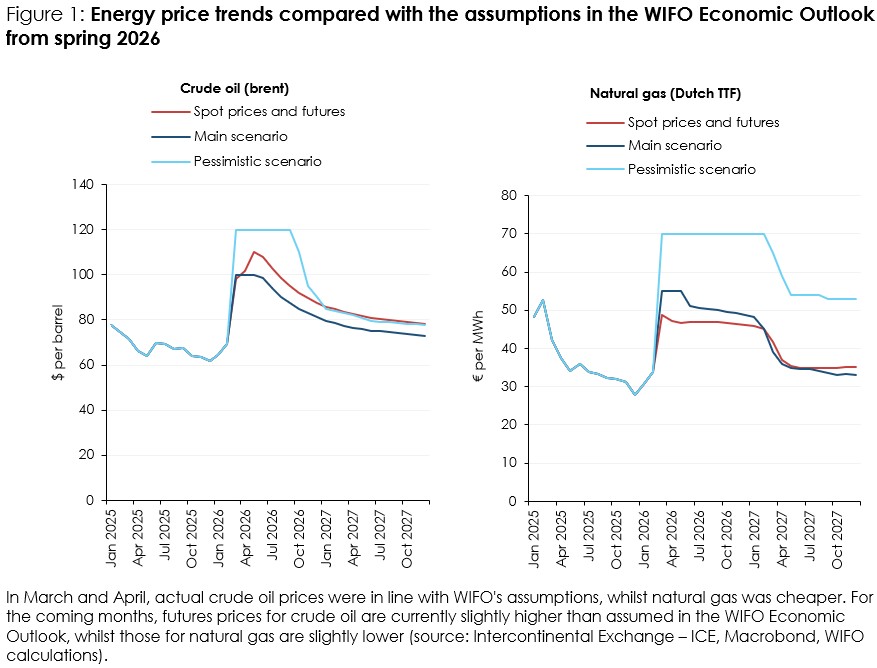
"According to market expectations, crude oil will be slightly more expensive in the coming months than assumed in the main scenario of the latest WIFO economic forecast, whilst natural gas will be slightly cheaper. However, price expectations remain significantly lower than assumed in the pessimistic scenario. In March and April, crude oil prices corresponded to the figures assumed in the WIFO Economic Outlook", says Stefan Ederer, author of the latest WIFO Business Cycle Report.
The consequences of the Iran war are weighing on the global economy. The Strait of Hormuz has been effectively blocked since the beginning of March. Brent crude oil cost an average of around 100 $ per barrel in March and April, whilst natural gas on the European market (Dutch TTF) cost around 50 € per MWh. According to futures market quotations from early May, energy prices are likely to remain at a similar level for several more months. Sentiment among service providers and consumer confidence have deteriorated in many places since the start of the war. Share prices fell significantly in March but have since recovered. Inflation rose worldwide as a result of the energy price shock.
Until the outbreak of the Iran war, the global economy was expanding strongly. According to the Centraal Planbureau (CPB), world trade and global industrial production increased noticeably. In the USA, the economy remained robust, and the economy in the euro area also expanded steadily. In Germany, the fiscal package was reflected in a renewed rise in GDP in the first quarter.
In Austria, the economy showed a slight upward trend in the first quarter of 2026. GDP is expected to have risen by 0.2 percent compared with the previous quarter. Exports stagnated and manufacturing value added fell compared with the previous quarter.
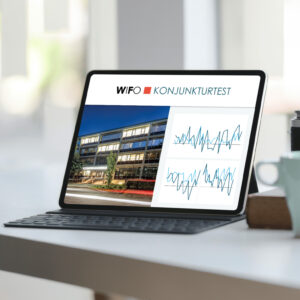
The effects of the Iran war are also dampening economic activity in Austria. According to the WIFO-Konjunkturtest (business cycle survey), assessments of the current situation and business expectations deteriorated in April and, on balance, were clearly in the pessimistic range. The WIFO-Konjunkturampel (economic traffic light) turned red in April.
Consumer price inflation rose in March and April and, according to a flash estimate by Statistics Austria, most recently stood at 3.3 percent. Energy was almost 11 percent more expensive than in the previous year. The number of persons in active employment is estimated to have been 0.8 percent higher in April than a year earlier. At the same time, however, the number of unemployed also rose. The unemployment rate is estimated at 7.5 percent according to the national definition.
Publications
Please contact

Further news