PASMA
The agricultural sector model PASMA (Positive Agricultural Sector Model for Austria; Schmid & Sinabell, 2003) was developed to estimate the effects of the 2003 CAP reform on agricultural production and selected agricultural and environmental indicators. The model has been continuously improved and expanded since then (e.g. Schmid et al., 2007ab; Kirchner et al.; 2015, Kirchner et al., 2016; Schönhart, et al., 2013, 2014, 2018).
As an important basis for agricultural policy analyses, PASMA depicts the political, natural and structural complexity of the Austrian agricultural sector in great detail, i.e. differentiated according to production activities and income opportunities. Figure 1 provides an overview of the structure and most important components of PASMA. The most important input data include the Integrated Administration and Control System (InVeKoS; Federal Ministry for Agriculture and Forestry, Environment and Water Management, 2017) , the Agricultural Structure Survey (e.g. Statistics Austria, 2022a), the Economic Accounts for Agriculture (e.g. Statistics Austria, 2022b), the estimate of agricultural labour force and standard gross margins (Federal Institute of Agricultural Economics, Rural and Mountain Research, 2025). The input data provide the necessary information to map the resources and production facilities at regional (NUTS-3) level in Austria.
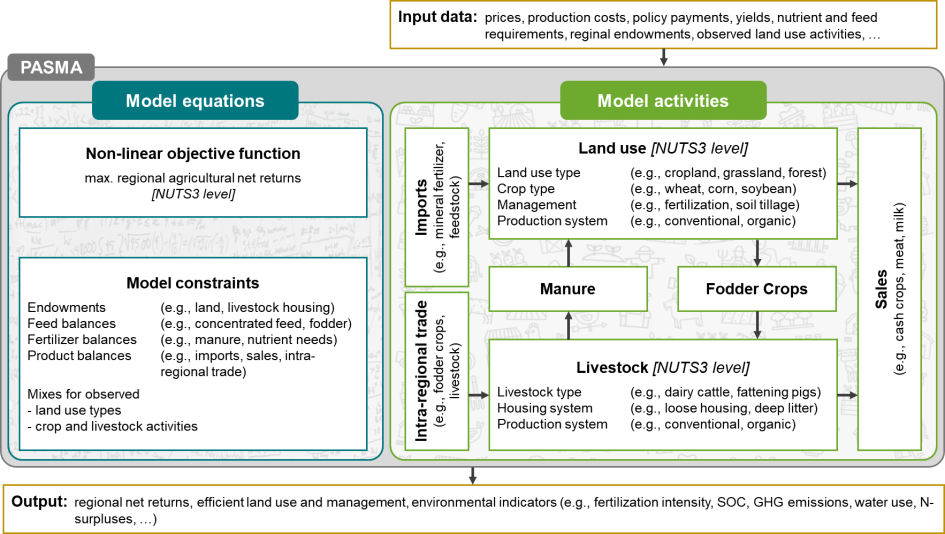
Two farm types (arable and livestock farms) and different farming systems (conventional and organic farming) as well as relevant management measures from the Austrian agri-environmental programme ÖPUL and the support programme for farms in disadvantaged areas (AZ) are mapped in PASMA. However, the detailed mapping of ÖPUL 2023 and the instrument mix after the reform of the Common Agricultural Policy in 2020 (i.e. in the GSP) requires an adjustment in the model structure and input data.
PASMA maximises the regional value added of farms and is calibrated to the observed situation using the Positive Mathematical Programming method (PMP; see Howitt, 1995; Heckelei et al., 2012). The PMP method is basically an extension of linear programming in which a profit-maximising equilibrium (i.e. marginal revenue equals marginal costs) is assumed in the base period. The coefficients of a non-linear target function are derived on the basis of the observed production activities.
PASMA is used to estimate agricultural production, labour, income and environmental indicators for each regional unit. The integration of economic and environmental indicators in a coherent framework is a key strength of PASMA and explains the frequent use of the model for agri-environmental analyses. Recent studies deal with evaluations (Sinabell et al., 2019) , scenario analyses and scenarios of the Austrian agricultural production system (Sinabell et al., 2019) and scenarios on greenhouse gas emission of the agricultural sector (Anderl et al., 2023; Sinabell et al., 2023).
Publications on PASMA
Contact