SHELScape
Natural disasters can generate large-scale shocks that disrupt socioeconomic systems through two primary channels. On the supply side, localised production losses, such as the destruction of agricultural output or damage to critical infrastructure, can lead to trade disruptions, shortages, and rising prices. On the demand side, households experiencing sudden income and employment losses may adjust behaviour through consumption smoothing, displacement, or migration. As documented in recent work on multi-layer behavioural networks, these supply- and demand-side responses interact and co-evolve, potentially amplifying the initial shock and transmitting it to non-affected regions through interconnected trade and mobility channels.
In the aftermath of a disaster, such interactions often give rise to strong negative feedback loops and non-linear transitions, particularly when critical economic thresholds are crossed. For instance, if household income drops below a minimum consumption requirement, affected populations may engage in coping strategies, running down savings or food inventories, selling assets, borrowing, or migrating, to avoid falling into severe vulnerability. These behavioural adjustments can create ripple effects across labour and goods markets, not only in disaster-stricken regions but also in receiving areas where sudden population inflows alter wages, prices, and local demand. Companies similarly respond to evolving market signals by adapting production decisions, reallocating supply across locations, or targeting new markets. Such adaptive processes, which occur simultaneously across supply and demand layers, contribute to complex cascading effects until the system moves toward a new post-shock equilibrium. While direct impacts of natural disasters are comparatively well understood, the indirect, distributed, and often cyclical nature of these cascades remains insufficiently explored and requires deeper investigation.
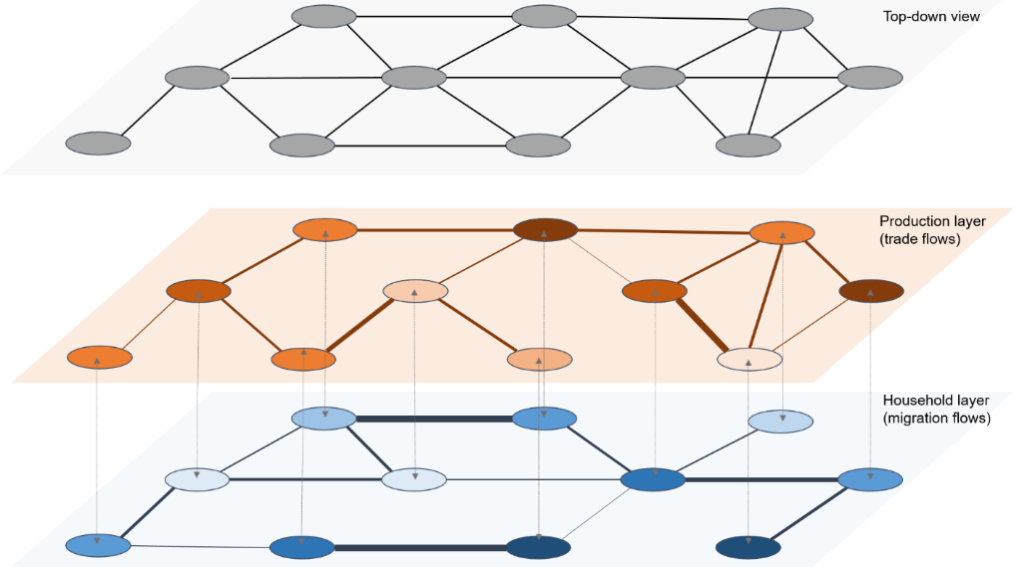
To study these complex dynamics, the spatially explicit, multi-layer agent-based model (ABM) SHELScape, integrates supply- and demand-side behaviours within a unified analytical framework. Inspired by recent advances in multi-layer network modelling, the framework represents the economy as a set of interconnected locations linked simultaneously through production-trade networks and household-migration networks. Agents, both companies and households, make production, trade, labour supply, and migration decisions based on empirically grounded behavioural rules and relative market signals. This structure captures the co-evolution of micro-level decision-making across network layers and allows us to trace how local shocks propagate through coupled economic, demographic, and spatial channels.
By simulating these adaptive responses, the model shows emergent dynamics such as cyclical vulnerability patterns, heterogeneous adjustment speeds across densely and sparsely connected regions, and the formation of vulnerability hotspots. These arise because interconnected layers transmit price and wage signals unevenly across space, generating reinforcing and balancing mechanisms that shape the recovery trajectory. The model thus reveals where and how market distortions, bottlenecks, and distributional effects materialise during the transition from the initial shock to the post-shock equilibrium.
This framework provides a foundation for designing more targeted and effective policy interventions. By explicitly accounting for feedback loops, behavioural thresholds, and multi-layer network interactions, the model highlights conditions under which local shocks can escalate into system-wide socioeconomic stress, offering insights critical for disaster risk reduction, resilience planning, and the allocation of scarce response resources.
Publications on SHELScape
Contact