Weekly WIFO Economic Index
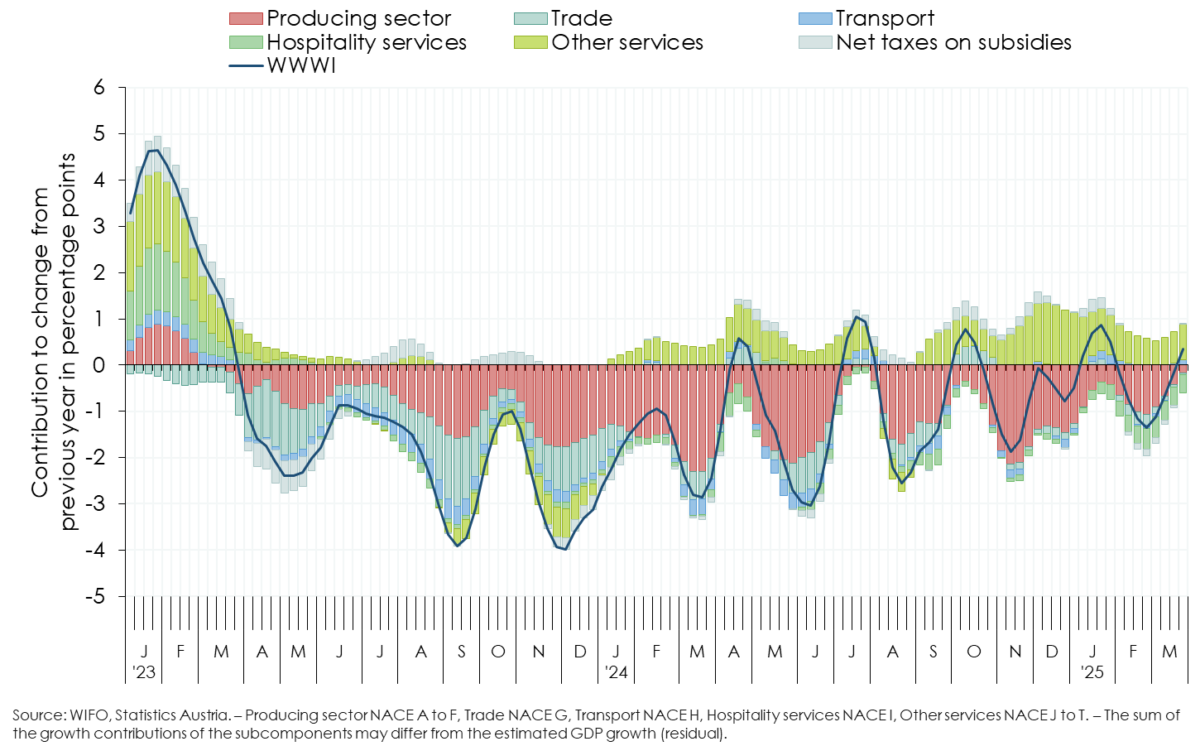
WWWI for GDP and its subcomponents
Based on the weekly indicator for GDP (WWWI), domestic economic output in January (calendar weeks 1 to 5, 29 December 2025 to 1 February 2026) was ¼ percent below the previous year's level, with one working day less. In the first two weeks of February (calendar weeks 6 and 7, 2 to 15 February 2026), it is expected to have been ½ percent higher (December 2025 +¼ percent, revised)1.
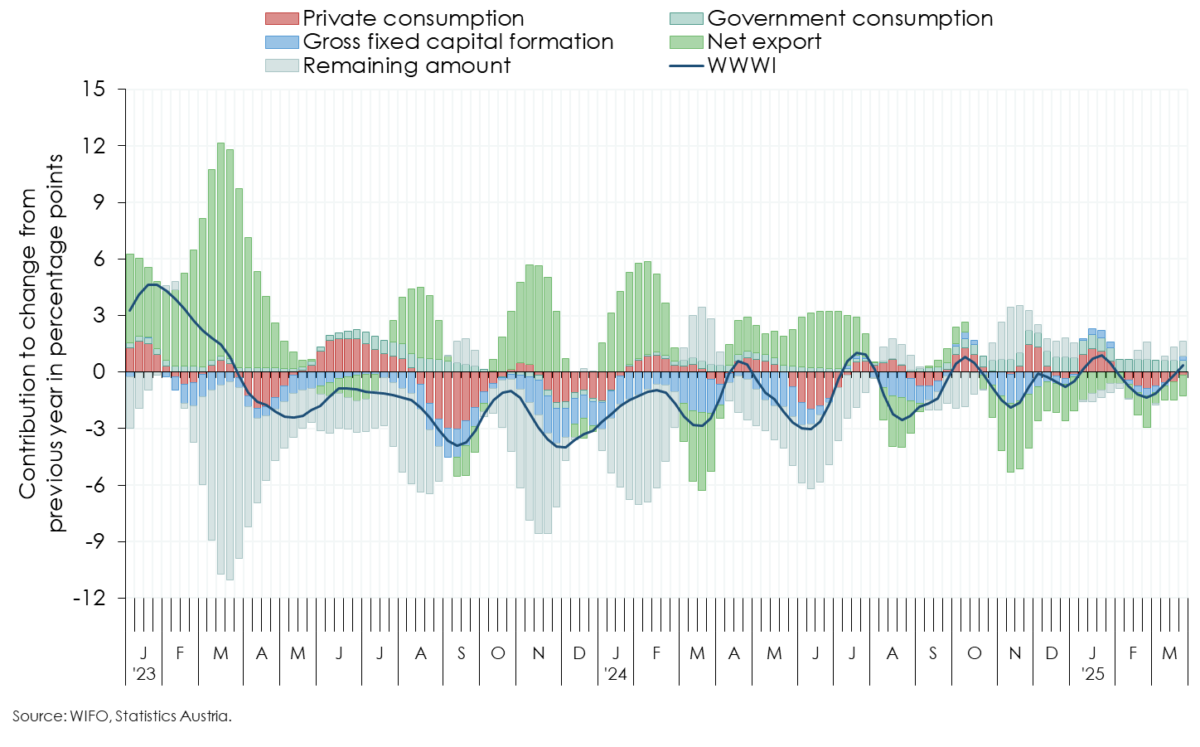
The inflation-adjusted volume of cashless transactions, serving as an indicator of household consumption expenditure, shows a year-on-year decline in demand for goods (retail sales) in January, while demand for services is estimated to have increased. Private consumption rose by 1¼ percent in January compared with the previous year and is expected to have increased by ¾ percent in the first two weeks of February (December 2025: 0 percent).
Gross fixed capital formation is driven by estimated economic output (industrial production) and by sentiment in manufacturing according to the WIFO-Konjunkturtest (business cycle survey). In December 2025 and January 2026, investment is estimated to have fallen by ½ percent compared with the previous year.
Based on developments in industrial production and tourism, as well as major demand components and the resulting effects on foreign trade, net exports in the broad sense made a negative contribution of 1¼ percentage points to GDP growth in January (December 2025 –1½ percentage points).
Truck mileage on Austria's motorways, rail freight transport and passenger and freight volumes at Vienna Airport declined in January compared with the previous year. According to the WIFO-Konjunkturtest, the majority of companies in the transport sector (NACE 2008, section H) continued to assess the current business situation as negative. Based on these indicators, a decline in value added of 3½ percent year-on-year is estimated for the transport sector in January (December 2025 –1¼ percent).
In January, employment in the goods-producing sector (NACE 2008, sections A to E) declined once more due to the recession, registering a decrease of 1½ percent compared to the same period last year. However, the number of job seekers in this sector has recently peaked. The WIFO-Konjunkturtest for manufacturing shows a clear recovery since the beginning of 2025, both in current assessments of the situation and in expectations for the coming months; on balance, however, assessments remain negative. Compared to the previous year, WIFO expects economic output in the goods-producing sector to have been 1 percent lower in January and 1 percent higher in the first half of February (December 2025 –½ percent)2.
January 2026 had one working day less and was significantly colder than in previous years. In addition, sentiment among construction companies remained sceptical – both the assessment of the current situation and expectations are still below the long-term average. Employment in construction continued to decline, and the number of persons registered as unemployed rose again in January compared with the previous year, following a decline in December 2025. Value added in construction (NACE 2008, section F) is estimated to have fallen by 5 percent in January and by 3¾ percent in the first two weeks of February, compared to the same period of the previous year (December 2025 –5½ percent).
Based on cashless transactions in restaurants and hotels and sentiment indicators from the WIFO-Konjunkturtest, value added in tourism (accommodation and food services, NACE 2008, section I) in January remained at the previous year's level and was 1 percent higher in the first half of February (December 2025 +2 percent). In trade (NACE 2008, section G), value added is expected to have stagnated in January and to have declined by ½ percent year-on-year in the first two weeks of February (December 2025 +1¾ percent).
The current employment situation in the remaining market-related services (NACE 2008, sections J to N) and the sentiment indicators from the WIFO-Konjunkturtest point to continued moderate positive development in this sector. Value added is estimated to have stagnated at the previous year's level in December 2025 and January 2026. In the first half of February, it is expected to have grown by ½ percent. Value added in other personal services (NACE 2008, sections R to T), based on employment trends and business expectations from the WIFO-Konjunkturtest, is likely to have increased by 2 percent in January compared with the previous year (first half of February 2026 +3½ percent, December 2025 –½ percent).
1 The inclusion of newly published and revised monthly data, which must be taken into account when estimating the WWWI, led to a revision of the WWWI for GDP. Notable supply-side WWWI revisions occurred particularly in the areas of goods production (NACE 2008, sections A to E), remaining market-related services (sections J to N), construction (sector F), trade (sector G), and accommodation and food services activities (section I).
2 For the WWWI estimates, unadjusted weekly and monthly data are modelled using a year-on-year comparison. The number of working days therefore has an impact on the change in value added. There was one working day less in January, while December 2025 and February 2026 had the same number of working days as in the previous year.
Weekly Economic Activity, WWWI – Production, WWWI – DemandThe WWWI is under constant development; it is regularly reviewed and will be expanded with new and additional weekly data series as they become available. The WWWI is not an official quarterly estimate, forecast or similar of WIFO.
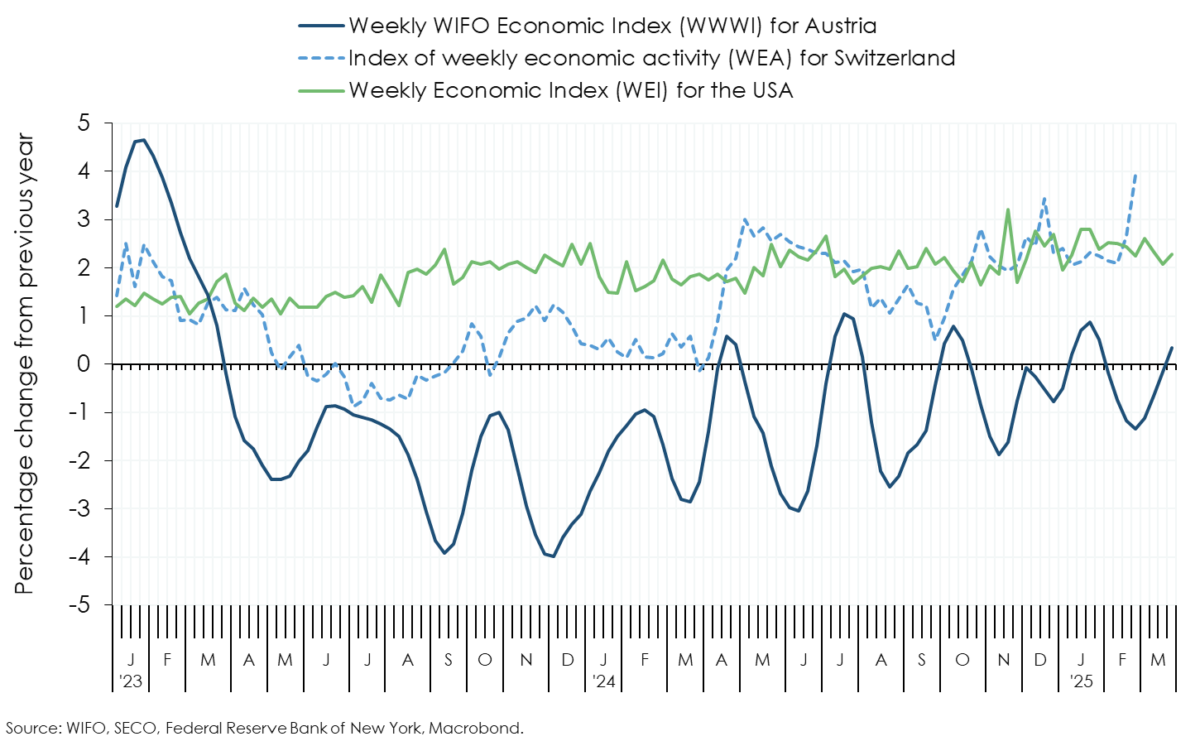
The WIFO Weekly Economic Index (WWWI) is a measure of the real economic activity of the Austrian economy on a weekly and monthly frequency. It is based on weekly, monthly and quarterly time series to estimate weekly and monthly indicators for real GDP and 18 GDP sub-aggregates (use side 8, production side 10) of the Quarterly National Accounts.
With the release for June 2022, the econometric models for the historical decompositions and for nowcasting have been converted to seasonally unadjusted time series. In addition, year-on-year growth rates are now used to estimate the models.
The WWWI estimates are (currently) updated monthly and published on the WIFO website.
Please contact

Further news